



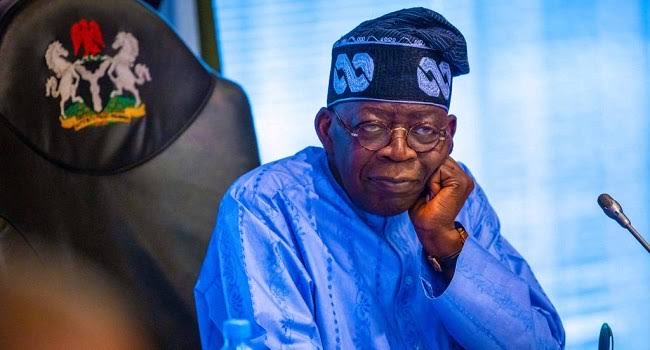
Tinubu’s nomination acceptance speech excites support groups
Now that the line-up of candidates for the 2027 Presidential election is almost complete, the Tinubu Media Support Group (TMSG) and Tinubu Stakeholders Forum (TSF) have expressed confidence that President Bola Tinubu’s acceptance speech after his endorsement for a second term by the ruling All Progressives Congress (APC) will resonate with many Nigerians on the need for continuity of the ongoing impactful reforms.
This, according to TMSG, is because the President’s reforms already referenced by the World Bank as a global template for emerging markets, are yielding tremendous dividends.
In a statement by its Chairman Emeka Nwankpa and Secretary Dapo Okubanjo, TMSG argued that President Tinubu’s solemn pledge to build on the reforms went a long way to convince several appreciative Nigerians who are now seeing a better economic trajectory in spite of the initial pains.
It said: ” We note that the stage is gradually being set for the January 2027 Presidential election with the emergence of opposition candidates, so it was not surprising that President Bola Tinubu is using every opportunity to reaffirm what his administration has been doing in the past three years.
“For us, there was no better time to pitch for a second term in office than during his acceptance of the mandate of more than 10 million registered members of the All Progressives Congress (APC) where the president made a strong, and compelling argument for continuity of the reforms.
”From all accounts, among his presidential rivals, he is comfortably way ahead of the curve having shown a strong fighting chance of driving the reform agenda to its logical conclusion.
“We acknowledge his position on the reforms initiated by his administration since assuming office and the initial pains but we also commend his uncanny boldness and insistence that difficult policy decisions were necessary to put the country on the path to long-term growth.
“It is a matter of public record that the foundation for the Tinubu reforms was the removal of fuel subsidy and the liberalisation of the foreign exchange market, and we affirm that these were necessary steps to stabilise the economy.
“So we make bold to say that President Tinubu’s assertion that the economy had ‘undergone significant structural reform, supported by new tax laws and fiscal policies that have boosted revenue collection for the federation’ is a statement of fact.
“This is clearly obvious from revenue accruing to the federation account which has seen a consequential increase in distributable revenue to all tiers of government from slightly above N900 billion in June 2023 to N2.036 trillion in April 2026
“But we are also of the view that the groundwork as well as the heavy lifting done by the Tinubu administration has to be sustained rather than disrupted by knee-jerk actions that could set the country back.”
TMSG argued that some of the achievements touted by President Tinubu on the economy are tangible enough to be referenced and promptly backed by international agencies and investors.
“The President also did not mince words in outlining achievements in macroeconomic management, infrastructural development, and education financing through the Nigerian Education Loan (NELFUND) which has now disbursed more than N282 billion to over 1.5 million beneficiaries in just about two years of operation.
“We are of the view that, despite heckles by those who still refuse to see the bigger picture, the reforms are now resonating with many Nigerians who have refused to be swayed by messengers of doom and gloom who are even using current fuel prices triggered by the ongoing Middle East crisis as a talking point.
“Our response to them is that if indeed the economy is not on the path to long-term growth and sustainability, the World Bank, for instance, would not be using the reforms as a global template for emerging markets.
“Also, the International Monetary Fund (IMF) would not list Nigeria among the 10 leading contributors to the global economy. In fact, Nigeria ranks 6th on the list and is the only African country in the list of top 10 contributors to global real GDP growth.
“This is aside from the various Final investment Decisions (FID) by International Oil Companies (IOCs) including Shell, TotalEnergies and ExxonMobil running into billions of dollars in response to new incentives introduced by the Tinubu administration to make the country more attractive for investments in the oil and gas sector.
“We need to add here that no other country in Africa has attracted the sort of FIDs Nigeria has recorded in the past two years. This is not by luck, or chance. It is the result of hard thinking.
“And coming at a time that Nigeria’s net foreign reserves rose to $34.8 billion from $3.99 billion, and gross reserves hitting the $50 billion mark, we are convinced that President Tinubu’s message of continuity will resonate with Nigerians more than the gloomy picture being painted by opposition figures,” it added.
The group urged Nigerians not to be swayed by the opposition but to show more trust in the process emplaced by the President Tinubu administration.
TSF) said Tinubu’s acceptance speech has placed the 2027 election in its proper national context.
In a statement signed by its Chairman Ahmad Sajoh and Secretary Danjuma Sada, the group described it as a choice between consolidating difficult but necessary reforms and returning Nigeria to the failed policies that weakened the economy for years.
TSF argued that President Tinubu’s speech after accepting the presidential nomination of the All Progressives Congress (APC), was not merely a political declaration, but a clear policy statement on continuity, national recovery, security, productivity and democratic consolidation.
According to the Forum, President Tinubu’s message was significant because it does not pretend that Nigeria’s challenges have disappeared. Rather, it acknowledges the pressure facing citizens while making the case that the responsible path is to deepen reforms, protect early gains and prevent a reversal to policies that produced fiscal instability, weak public investment, infrastructure decay and economic vulnerability.
“Nigeria cannot afford to treat 2027 as a referendum on temporary discomfort alone. It must be seen as a national decision on whether the country will consolidate reforms or return to the failed choices that created the crisis in the first place,” TSF said.
The Forum noted that President Tinubu’s speech correctly framed continuity as a matter of national responsibility, not political convenience.
“Like many people, we are aware that the first phase of the administration has been devoted to correcting structural distortions in subsidy payments, foreign exchange management, revenue mobilisation, public finance and investment planning.
“And while these reforms have come with difficult adjustment pressures, abandoning them midway would expose the country to greater instability and reverse the foundations already being laid for recovery, investment, productivity and inclusive growth.
“For us, the President’s reference to the Nigerian Education Loan Fund was particularly important because it shows that reform is not only about macroeconomic stability, but also about expanding opportunity for ordinary Nigerians.
“In two years, we have seen how the education loan scheme has opened a new pathway for students from low and middle-income families to access tertiary education without being shut out by financial hardship.
“It is one of the strongest examples of how the administration is using public policy to promote social mobility, youth empowerment and human capital development,” the group added.
On the power sector, TSF welcomed the President’s emphasis on metering, debt settlement and sector bankability.
“The Presidential Metering Initiative as well as efforts to close the metering gap, and the structured settlement of verified legacy debts owed to generation companies and gas suppliers are necessary steps toward rebuilding confidence in the electricity value chain.
“We believe that we cannot achieve industrialisation, manufacturing expansion, digital growth or small business competitiveness without a power sector that is financially stable, investable and capable of delivering reliable electricity to homes and industries.
“So Power reform is not a slogan. It requires metering, liquidity, investor confidence, gas supply stability and disciplined regulation. The Tinubu administration is addressing the foundations that previous governments avoided or postponed,” TSF said.
On the economy, the Forum said the President’s defence of subsidy removal, exchange rate reform, new tax laws and improved fiscal coordination should be understood within the broader need to move Nigeria away from wasteful consumption subsidies and weak revenue systems toward a more productive national economy.
TSF said the removal of distortions in the economy is already helping to restore the basis for stronger reserves, improved revenue performance, better investment planning and more credible public finance.
It, however, urged the Federal Government to continue expanding targeted support for vulnerable households, workers, small businesses, students and farmers so that the benefits of reform can reach citizens faster and more visibly.
TSF also cautioned opposition politicians against criticising without presenting credible alternatives, saying Nigeria’s challenges require practical plans, not slogans.
“Those who seek to lead the country must explain whether they intend to reverse subsidy reforms, return to multiple exchange rates, weaken fiscal discipline, abandon power sector restructuring, halt strategic capital projects or dismantle the reforms now restoring investor confidence.
“The President, on his part, has made it clear that the work is unfinisHonesty is important. The answer to unfinished reform is not reversal; it is disciplined continuity, faster implementation and stronger delivery.
“President Tinubu’s acceptance speech has offered Nigerians a clear choice: to consolidate progress or risk reversal; to build on reform or retreat into the past; to strengthen the foundations of a modern Nigeria or return to the policies that held the country down,” it noted.
End