



Ten years ago, talk of a Cambodian “logistics corridor” would have raised a smile. Today, the country is quietly but genuinely establishing itself as one of the relay points of Asia’s industrial relocation.
That is what the latest industrial and logistics market overview, published by property platform realestate.com.kh and compiling data from Cambodia’s General Department of Customs and Excise (GDCE), the Council for the Development of Cambodia (CDC) and the Ministry of Commerce, sets out to demonstrate, figures in hand.
- The “China+1” playbook
- The diagnosis boils down to a well-worn but still effective formula: Cambodia is a direct beneficiary of the “China+1” strategy, the reshuffling of global supply chains pushing manufacturers to diversify their production bases beyond China. Add to that operating costs that remain competitive against regional peers, preferential access to European and Asian markets through the EBA (Everything But Arms) and RCEP trade regimes, and a growing domestic consumer market that is in turn fuelling demand for warehousing and last-mile logistics around Phnom Penh.
- Garments and apparel remain the historic backbone of the manufacturing base, but the report points to the rise of more diversified sectors: electronics, automotive components, bicycle manufacturing, agri-processing and furniture and wood products now round out an industrial fabric that is far less mono-sector than it was a decade ago.
The great infrastructure push
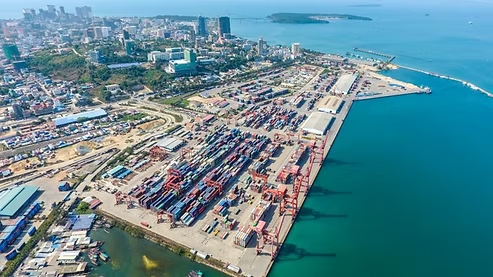
The real shift, however, is playing out on asphalt and rail. The Phnom Penh–Sihanoukville Expressway, completed in 2023, cut the journey to the deep-water port to under two hours, turning the entire National Road 4 corridor into the country’s industrial backbone in the process. The new Techo International Airport, 24 km south of the capital, is meanwhile expected to anchor demand for air freight and cold-chain facilities along National Road 2.
Other projects are still under way: the Phnom Penh–Bavet Expressway is set to open up the eastern industrial corridor toward the Vietnamese border, the expansion of Sihanoukville Port is meant to absorb growing export volumes from the special economic zones, and the southern rail line linking the capital to the coast is being upgraded for freight capacity. The most spectacular project remains the Funan Techo Canal, a 180 km inland waterway designed to link Phnom Penh to the sea and free bulk cargo routes from having to pass through Vietnam — with commissioning targeted for 2028.
Read more