



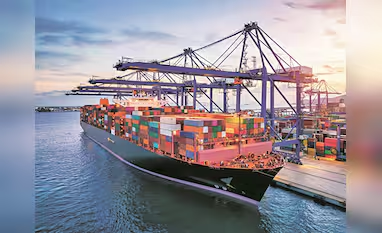
India is preparing the most extensive overhaul of its Special Economic Zone (SEZ) framework since the SEZ Act came into force in 2005, as policymakers seek to revive a model that was once at the centre of the country’s export strategy.
The proposed reforms, often referred to as SEZ 2.0, come at a time when India’s manufacturing ambitions, global trade realities and investment priorities look very different from two decades ago.
The changes under discussion include easier access to the domestic market, more flexible operational rules, changes to net foreign exchange requirements and closer integration with global value chains.
But why is India revisiting a policy that once played a central role in attracting investment and boosting exports?
The promise of the 2005 model
The SEZ Act was introduced to address long-standing problems that had constrained India’s export sector, including cumbersome approvals, weak infrastructure and policy uncertainty.
According to Nilanjan Banik, professor at Mahindra University, the SEZ framework was designed to create hassle-free export environments backed by single-window clearances and better infrastructure. The aim was to improve export competitiveness while attracting domestic and foreign investment.
The policy initially delivered results. SEZs emerged as major export hubs, particularly for information technology, pharmaceuticals, engineering and electronics. They attracted private investment, generated employment and helped create dedicated industrial ecosystems.
Mahendra Chouhan, president of IMC Chamber of Commerce and Industry, said the SEZ programme contributed to exports, investment and job creation, while developing quality infrastructure across several sectors.
However, he added that manufacturing expansion fell short of expectations and many approved zones remained underutilised. ALSO READ: Govt plans wide-ranging reforms to modernise SEZ regime, spur investments
Industry experts and policy observers point to several developments that gradually weakened the original SEZ value proposition.
Read more