


Myanmar’s Vice President U Nyo Saw has called for faster implementation of the country’s Special Economic Zones (SEZs) to boost exports, attract foreign investment, creat jobs and increase foreign exchange earnings.
Speaking at a coordination meeting of the Central Body for Myanmar Special Economic Zones in Nay Pyi Taw on 3 July, he urged stronger links between domestic micro, small and medium-sized enterprises (MSMEs) and businesses operating in the Thilawa SEZ to support economic growth.
He also instructed authorities to keep the Kyaukphyu and Dawei SEZs, along with the Dawei Deep-Sea Port project, on schedule, improve project management, attract more investors and ensure compliance with SEZ laws and regulations.
Officials from the Thilawa, Kyaukphyu and Dawei SEZs briefed the meeting on project progress, management, land compensation, expansion plans and business operations, while senior government officials reviewed legal and contractual matters related to the developments.
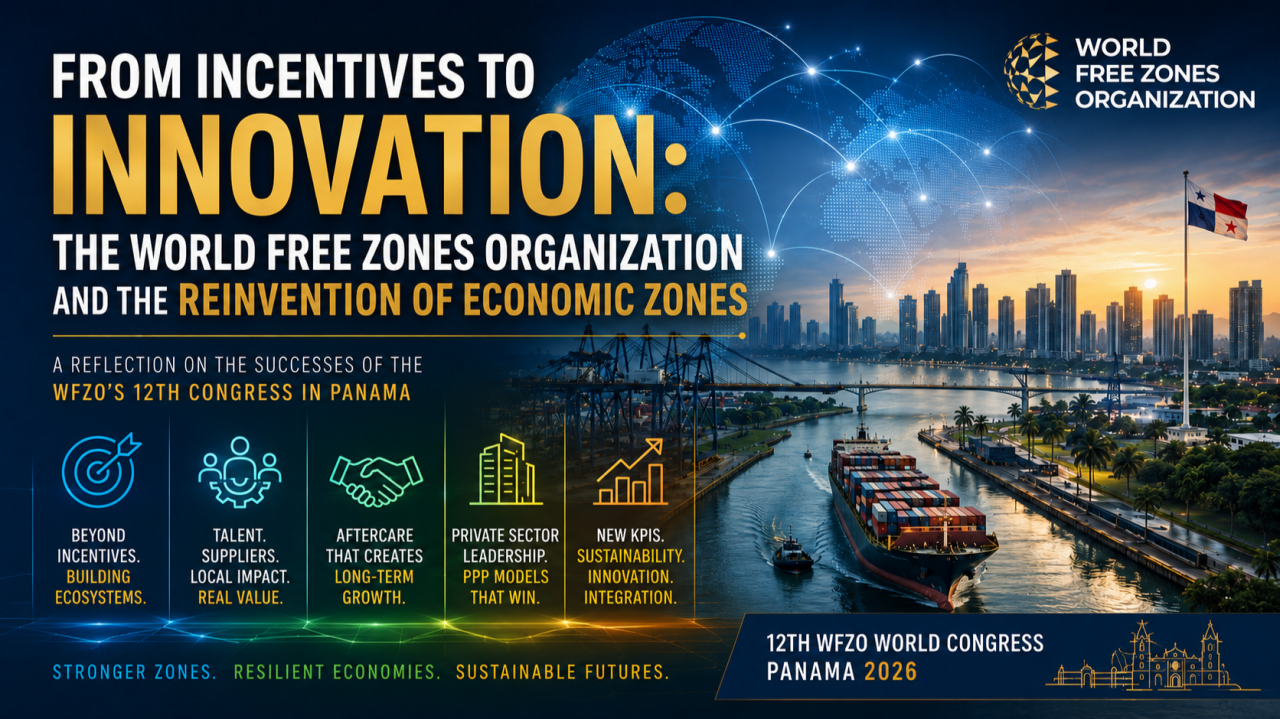
The 12th World Free Zones Organization (WFZO) World Congress in Panama was more than another international conference. It was a statement about the growing importance of free zones and special economic zones (SEZs) in a world increasingly defined by geopolitical uncertainty, supply chain reconfiguration, sustainability imperatives, and competition for investment.
Viewed from my vantage point as Knowledge Advisor to the WFZO and as someone involved in both the planning and execution of the Congress, the event was a story of achievement, institutional maturity, and strategic evolution. It also marked the end of one era and the beginning of another.
The Congress served as a fitting swan song for Dr. Dr. Samir Hamrouni , the founding Chief Executive Officer of the WFZO, who has led the organization for the past twelve years.
When Dr. Hamrouni began the journey in 2014, the ambition was to create a unified global voice for free zones.
Today, the organization brings together more than 1,600 members across 142 countries, supported by ten regional offices and forty-five national contact points. Under his stewardship, the WFZO evolved from a bold idea into the world’s leading platform for free zone cooperation, advocacy, research, and knowledge exchange.
Read more