



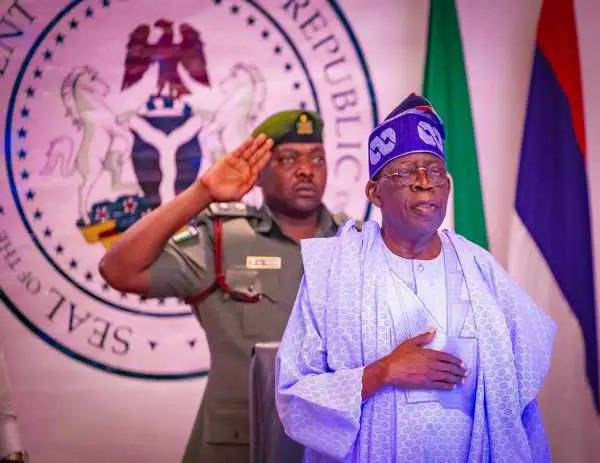
The Independent Media and Policy Initiative (IMPI), a national Think Tank, has noted that but for the historic resilience and patriotic endurance of Nigerian people, the President Bola Ahmed Tinubu’s bold programmatic and economic transition would have collapsed.
By resisting the temptation to revert to unsustainable populism, citizens have provided the bedrock stability required for these reforms to mature, IMPI said in a statement released by its Chairman, Dr Omoniyi Akinsiju.
The statement, “Nigerians as Actual Executors of Tinubu’s Reforms as Economy Transit from Consumption to Productivity’ released on July 31, 2026 in Abuja, Akinsiju said that the success and long-term sustainability of the economic reforms were profoundly dependent on the Nigerian public.
Nigerians, he said, functioned simultaneously as the “primary shock absorbers, the ultimate arbiters of accountability, and the engine of behavioural realignment required for a market-driven economy’’.
“Rather than being passive spectators, we have observed the role of Nigerians in three critical dimensions in the sacrifice phase of bearing the immediate structural shock; enforcing fiscal accountability and the Social Contract; and the driving behavioural shifts and local productivity.
“The most immediate and painful role Nigerians have played is absorbing the massive inflationary and cost-of-living shocks triggered by orthodox economic corrections.
“By enduring the immediate spiralling costs of transportation, food, and energy following the removal of fuel subsidy and the floating of the Naira, the public has effectively provided the “fiscal breathing room” the government needed to prevent a sovereign default, and rebuild external reserves.
“The sheer resilience of Nigerian households and MSMEs (Micro, Small, and Medium Enterprises) in adapting to these harsh macroeconomic realities has kept the economy functioning, and prevent widespread structural collapse during the hyper-inflationary peaks of 2024 and 2025,’’ he explained.
He explained also that for market reforms to succeed, global investors and local citizens alike must see that saved revenues are being utilized transparently and that Nigerians play a vital role here as enforcers of the social contract.
Through civil society advocacy and public discourse as well as social media engagements, he explained that Nigerians consistently demanded that the trillions of Naira saved from subsidy removal be visibly channeled into tangible infrastructure, healthcare, and human capital development rather than bureaucratic waste.
“The success of targeted mitigation frameworks such as the student loan scheme (NELFUND), compressed natural gas (CNG) transport initiatives, and direct cash transfers relies entirely on the public actively participating in monitoring and holding these institutions accountable to ensure benefits are not swallowed by corruption.’’
Akinsiju also explained that long-term economic stability could not rely on central bank interventions or foreign portfolio investments alone, but required structural shift in how Nigerians produced and consumed.
“As the floating of the Naira makes imported goods exponentially more expensive, the role of Nigerian consumers and businesses is shifting towards “Buying Nigerian”, supporting local manufacturing, agriculture, and tech startups and it’s what will ultimately reduce the country’s systemic vulnerability to foreign exchange volatility.
“As the administration seeks to aggressively boost non-oil revenue, citizens and businesses transitioning into the formal economy play a vital role in building a sustainable, tax-funded fiscal architecture, reducing Nigeria’s historical dependence on volatile oil windfalls.’’
He said that to fully appreciate the scope of the current economic transformation, “we must analyze it against the backdrop of historical policy choices’’, explaining that for over two decades, the management of Nigeria’s economy was characterized by an adherence to command-and-control monetary policies and heavily subsidized consumption models which eroded national reserves and systematically disincentivized domestic production.
“Historically, whenever the currency experienced depreciation pressure, previous administrations routinely panic and capitulate to short-term political backlash by reinstating artificial pegs and capital controls. This cyclical retreat created fertile ground for illicit arbitrage, enriched a small class of non-productive rent-seekers, and starved critical sectors such as manufacturing, processing, and public infrastructure of vital capital.
“The immediate result was an economy built on quicksand: highly susceptible to global oil shocks, structurally deficient, and incapable of sustaining organic growth.
“In sharp contrast, the Tinubu administration has broken this cycle by addressing the root causes of our economic challenges. Rather than burn billions of dollars monthly to defend an artificial exchange rate, the current administration has unified the market, allowed transparent pricing mechanisms to take hold, and completely eliminated the corruption-laden petrol subsidy.
“By taking the “bitter medicine” that previous governments avoided, this federal administration has fundamentally changed the global perception of the Nigerian marketplace. Investors no longer view Nigeria as a volatile, state-managed playground, but rather as a serious, transparent frontier market willing to make difficult choices to secure its economic future,’’ Akinsiju said.
The core philosophy driving the current structural reform agenda, he said, was simple but profound – Nigeria must produce what it consumes and add value to what it exports.
“The transition to a production-based economy is being driven by a combination of aggressive fiscal adjustments, institutional digitization, and long-term industrial planning,’’ he noted.